There is an uncomfortable truth at the centre of this topic: raw reaction speed — the delay between an unpredictable signal and your response — barely improves with practice.
The good news is that raw reaction speed is almost never what limits you in an arcade game.
What actually gets faster
When an experienced player looks fast, three things are happening that a new player is not doing.
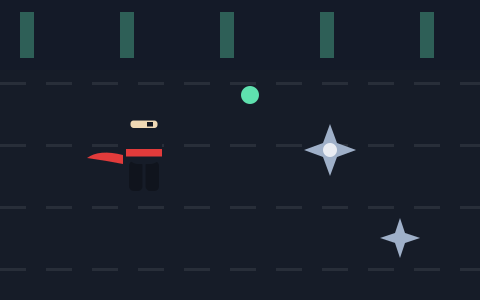
They have narrowed the possibilities. In Shuriken Sprint a beginner sees "something is coming" and then works out what and where. An experienced player already knows there will be one or two discs in a subset of three lanes. They are choosing between known options, not identifying unknown ones.
They are responding to precursors. In Ninja Dash, a crate and a beam look different in silhouette and colour from the moment they enter the screen. Reading the silhouette rather than the object saves a meaningful chunk of the window.
They have pre-loaded the response. When you already know that the answer is "jump", the motor command is partly prepared. The delay between decision and action shrinks because the decision happened earlier.
All three of those are learning, not biology. That is where your improvement comes from.
Five techniques
1. Read the silhouette, not the object
Shape and colour resolve faster than detail. Every game here uses consistent visual language — brown boxes sit on the ground, red-edged beams hang overhead — precisely so this works.
2. Track the gap, not the hazards
When two things arrive at once, find the empty space instead of tracking both objects. It converts a two-object tracking task into a one-object search, which is dramatically faster.
In Shuriken Sprint this single change usually produces an immediate score jump.
3. Press on approach, not on arrival
For any timing window, your press should start before the target is inside it. Visual confirmation costs a couple of hundred milliseconds, and at speed a window can be shorter than that.
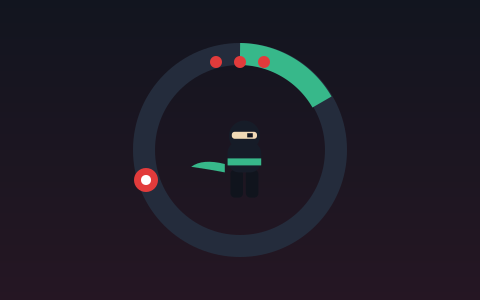
Ninja Reflex at full speed has a window of about 35 milliseconds. Nobody reacts inside that. You anticipate it or you miss.
4. Default to the safest position
In lane games, sit in the middle by default. From the centre, every lane is one input away; from an outside lane, a centre hazard forces a two-lane move under pressure.
This is not reaction training — it is reducing how much reaction you need.
5. Play the same game repeatedly
Priors are game-specific. Ten runs of one game builds the narrowed possibility space that makes you look fast; one run of ten games builds nothing.
What does not work
Reaction-time trainers, for this purpose. They measure the part that does not transfer. Getting quicker at clicking when a square turns green will not help you read a Ninja Dash obstacle sequence.
Concentrating harder. Effort does not shorten perceptual latency. Better anticipation does.
Mashing. In reaction games an input outside the window is an error, not a free attempt. In Ninja Reflex every stray press costs a life.
Caffeine past your normal amount. Beyond your usual intake it tends to increase variability rather than reduce latency, and consistency matters more than peak speed in these games.
What we are not claiming
Practising these games will make you better at these games. Whether that transfers to reaction speed in daily life is a much bigger question, and one a browser games site is not in a position to answer.
If a site tells you its arcade game is proven to sharpen your reflexes, ask what study they are citing. We do not make that claim, and our fact-checking policy explains why.
Key takeaways
- Raw reaction speed is close to fixed; what improves is anticipation, pattern priors and pre-loaded responses.
- Read silhouettes rather than objects, and track the gap rather than the hazards.
- Press on approach: at high speed, timing windows are shorter than visual confirmation.
- Reduce how much reaction you need by defaulting to the safest position.
- Improvement is game-specific — stay with one game per session.
Frequently asked questions
Can you train your reaction time?
Raw reaction time improves very little. What improves substantially is anticipation — knowing what is likely to happen and having a response partly prepared.
Why do experienced players look so much faster?
Because they are choosing between known options rather than identifying unknown ones. Most of their apparent speed was bought before the hazard appeared.
Do reaction-time trainers help with arcade games?
Not much. They train the part that does not transfer. Playing the specific game builds the priors that actually make you faster in it.
What is the best game for practising reactions?
Ninja Reflex for pure timing, Shuriken Sprint for identification under pressure. They exercise different halves of the problem.
Ready to put this into practice?
Everything above is easier to feel than to read about. Open the game and try one run with just one of these ideas in mind.