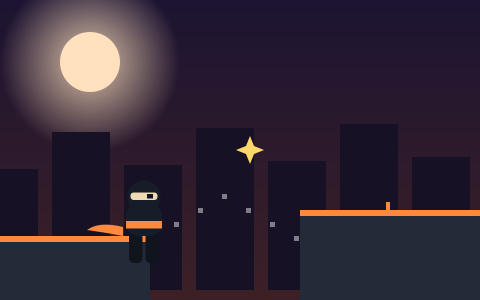
Shadow Jump
Bounce endlessly up a ninja tower, steering between platforms as they narrow.
Platform games are about controlling a jump you have already committed to. Once the ninja leaves the ground, the arc is set — all you can change is how you set it up.
The five platformers below cover the main shapes the genre takes: vertical towers you climb, precision leaps between fixed targets, wall-jump shafts, and a level-based side-scroller with lives and a goal at the end of each stage.
Bounce endlessly up a ninja tower, steering between platforms as they narrow.
Charge each leap and land dead centre for an eight-step perfect combo.
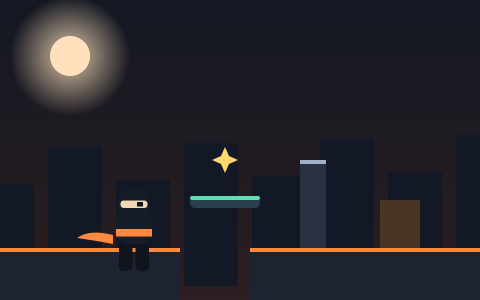
A full side-scrolling platformer with levels, lives and a double jump power-up.
Designed obstacle blocks: crate hops, slide beams, wall jumps and moving platforms.
A jump that feels right is usually one where the player can predict the landing before they press the button. Three settings control that: the upward velocity at take-off, the downward acceleration applied every frame, and whether holding the button extends the rise.
In Mystic Ninja the ninja leaves the ground at 700 pixels per second upward against 2,000 pixels per second squared of gravity, which produces an apex of roughly 122 pixels and about 0.7 seconds of air time. Every platform in every generated level is placed inside that envelope, which is what stops the generator from ever building a gap you cannot cross.
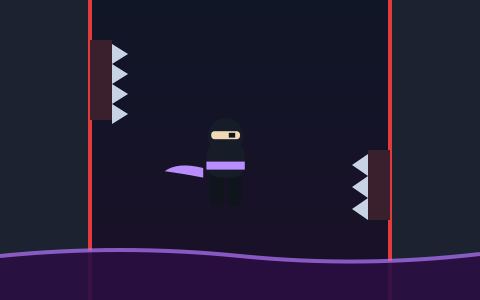
A wall jump converts contact with a vertical surface into a new jump. In Ninja Climb the ninja clings to whichever wall she touches and slides slowly down it; pressing jump launches her diagonally at the opposite wall. Because the horizontal velocity is fixed, the timing question is when to leave, not how hard to push.
Shadow Jump uses a looser version: the side walls of the tower act as emergency platforms, so a badly aimed bounce can be recovered by drifting into the wall instead of falling.
These are the areas this section of Ninja Arcade covers. Each one connects to the games above and to the guides that explain them.
Shadow Jump, because the ninja bounces automatically on every platform. You only steer left and right, so there is no jump timing to learn.
Mystic Ninja. It has three lives, a gate at the end of each level, and a clear bonus that grows with every level you finish.
Release the movement key before you reach the edge. Momentum carries the ninja further than most players expect, especially in Shadow Jump.
In a vertical game gravity is permanently working against your score. That single asymmetry shapes the camera, the scoring and the pacing devices these games need.
Variable jump height turns a binary button into a continuous range of arcs. Here are the two ways games implement it, and the problem it creates for touchscreens.
Landing on a platform and bumping into its side are the same overlap until the game separates the axes. Here is how platform collision is actually resolved.
Good arcade levels teach without tutorials and pace without pausing. Here are the working rules behind the courses in these games, useful whether you play or build them.
When a section keeps beating you, playing it faster is rarely the answer. Six tactics for breaking down a platform sequence that has become a wall.
Parkour games charge you for hesitating. These six strategies are about spending that time deliberately instead of losing it to nerves.