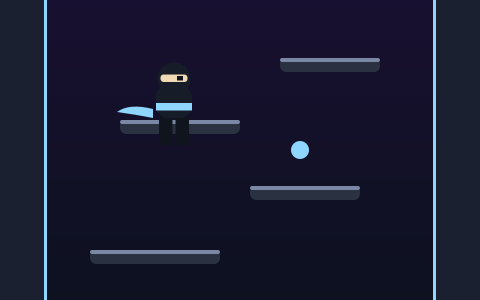
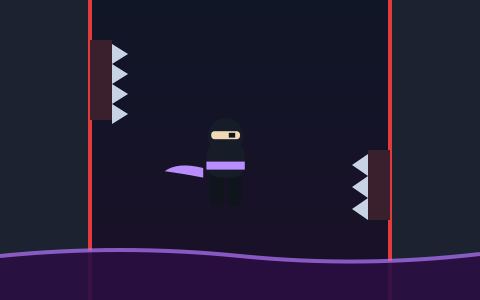
A horizontal game is neutral about standing still. A vertical game is not: gravity is always pulling your score back down. Everything distinctive about the genre follows from that asymmetry.
Height is the score
In Shadow Jump, score is height climbed divided by ten. In Ninja Climb it is divided by six. Collectibles add a little, but the climb dominates.
This is neat because the score is also the progress bar, the difficulty indicator and the goal, all in one number. There is nothing to explain.
It also means score can only increase in one direction, which makes hesitation directly expensive — in Ninja Climb the ninja slides down a wall at 120 pixels per second while she clings.
The world moves, not the camera
Vertical games almost never move a camera. Instead, when the character rises past a threshold, the whole world shifts downward and the character stays put.
var threshold = H * 0.36;
if (py < threshold) {
  var shift = threshold - py;
  py = threshold;
  height += shift;
  platforms.forEach(function (p) { p.y += shift; });
}
Two things fall out of this. The character never leaves the comfortable part of the screen, and the height counter is simply the accumulated shift — no separate tracking required.
The practical effect for you as a player: you always have the same amount of screen above you, so your planning distance never changes.
Why hesitation costs twice
Pausing in a vertical game costs the height you did not gain and the height you lose while pausing.
Ninja Climb doubles down on this with a rising flood that accelerates over time. Standing still is not merely slow — it is actively losing ground to something that will end the run.
Which is why the first rule of vertical play is: jump the instant you land, unless you are waiting for something you can name.
Two solutions to the pacing problem
A relentless climb with no structure is exhausting. The genre has two standard answers.
Automatic bouncing. Shadow Jump rebounds the ninja on every landing, removing the decision to move entirely. The player only steers, which turns the game into pure momentum management and takes all the pressure off timing.
Checkpoints. Ninja Climb pushes the flood back below the screen every 1,200 height and pays 150 points. That gives the climb a rhythm of squeeze and release rather than one continuous tightening.
Both work. They produce completely different games from nearly identical physics.
Reading a vertical layout
Three habits worth building:
Look up, not at the character. The next two platforms matter; the one you are on does not.
Aim for centres as platforms narrow. Shadow Jump's platforms shrink from 150 pixels to a floor of 64. An edge-aimed landing that worked early fails reliably later.
Use the walls. Both games have side walls that act as recovery surfaces. Drifting into one when a platform drifts away is better than chasing it.
Why falling is so punishing
In a horizontal game, falling into a pit costs you a life or a run. In a vertical game, falling costs score — you are being dragged back through height you already earned.
Games soften this in different ways. Shadow Jump only ends the run when you drop off the bottom of the screen, so a long fall through several platforms is survivable if you catch one. Ninja Climb replaces the bottom of the screen with the rising flood, making the fall distance you can survive shrink over time.
Knowing which model you are in tells you how much a slip costs.
Key takeaways
- Height is the score, the progress bar and the difficulty indicator at once.
- The world shifts downward rather than a camera moving up, which keeps planning distance constant.
- Hesitation costs twice, which is why good vertical play means jumping the moment you land.
- The two pacing solutions are automatic bouncing and checkpoints; they produce very different games.
- Look up rather than at the character, aim for centres, and use walls as recovery surfaces.
Frequently asked questions
How is score calculated in vertical ninja games?
By height climbed — one point per ten pixels in Shadow Jump, one per six in Ninja Climb — plus a small amount for collectibles.
Why does my ninja slide down the wall in Ninja Climb?
Clinging is not free. The ninja slides at 120 pixels per second while attached, so waiting costs height directly.
What is the best vertical ninja game for beginners?
Shadow Jump. Automatic bouncing removes jump timing entirely, leaving only steering.
Do checkpoints save my position?
Not in these games. Ninja Climb's checkpoints reset the rising flood and pay a bonus; your position does not change.
Ready to put this into practice?
Everything above is easier to feel than to read about. Open the game and try one run with just one of these ideas in mind.