Shadow Jump
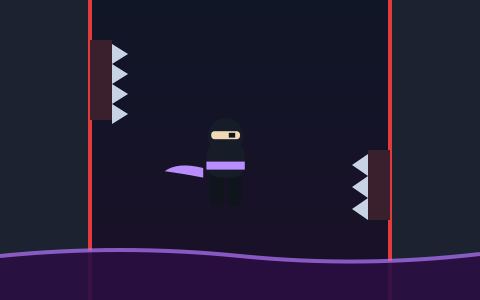
Bounce endlessly up a ninja tower, steering between platforms as they narrow.
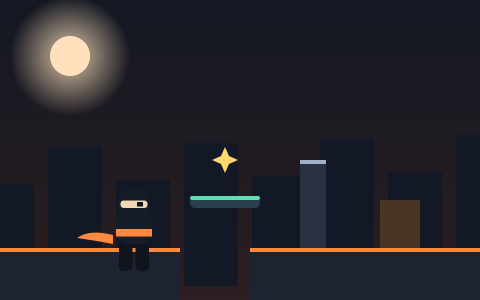
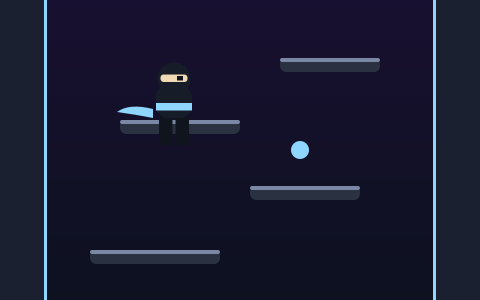
Rooftop Ninja is a precision platformer about one decision made over and over: how long to hold the jump. Charge too little and you fall short, too much and you overshoot the landing zone. Land near the centre for a perfect and a bigger combo.
Every jump in Rooftop Ninja is set before it starts. Holding the jump key fills a power meter at 1.35 units per second; releasing launches the ninja at a horizontal speed between 190 and 660 pixels per second and a vertical speed between 360 and 660. Once she is airborne, nothing you press changes the arc.
Because the game asks you to predict rather than react, it shows you the prediction. While you charge, a dotted arc traces exactly where the ninja will travel. This is deliberate: the challenge is releasing the key at the right moment, not guessing what the physics will do.
Landing near the centre of a rooftop — within 26% of the half-width — counts as a perfect landing. Perfects stack into a combo that caps at eight, and the combo multiplies both landing points and the stars floating above the gaps. A sloppy landing does not kill you, but it resets the combo to one.
Gaps are generated against the maximum achievable arc, with extra margin subtracted whenever the next rooftop sits higher than the one you are leaving. From the third tier onward some rooftops bob up and down, which adds a timing element to what is otherwise a pure distance judgement.
| Action | Keys |
|---|---|
| Charge jump | Hold Space or ↑ or W |
| Release jump | Release the key |
| Pause / resume | P or Esc |
| Mute | M |
| Action | Gesture |
|---|---|
| Charge jump | Press and hold anywhere on the play area |
| Release jump | Lift your finger |
| Alternative | Hold the on-screen Jump button |
Pause works everywhere with the Pause button under the play area. Game audio is a handful of synthesised arcade tones — mute it with M or the Sound button, and the setting carries across every game on the site.
Most gaps fall into short, medium and long. Practise the feel of a quarter, half and three-quarter meter, and you will clear most of the game without fine-tuning.
When the next rooftop is higher than the one you are on, the arc loses horizontal distance to the climb. Add a touch more charge than the gap looks like it needs.
A narrow rooftop has a small perfect zone but the same fatal edges. Landing safely and resetting the combo is better than missing the roof entirely.
A moving rooftop is easiest to hit when it is at the bottom of its travel, because the effective landing window is longest there.
The dotted trajectory is the only information that matters while charging. Track its tip against the target rooftop.
Hold the jump key longer. The power meter fills over about three quarters of a second, and both horizontal and vertical launch speed scale with it.
Landing with the ninja's centre within 26% of the rooftop's half-width of its middle. The small orange marker shows you where that is.
Combos only continue on perfect landings. A safe but off-centre landing is worth 30 points and sets the multiplier back to one.
It is the hardest game on the site. If you are new, start with Shadow Jump or Ninja Reflex and come back once charged jumping feels natural.
Bounce endlessly up a ninja tower, steering between platforms as they narrow.
Designed obstacle blocks: crate hops, slide beams, wall jumps and moving platforms.
Designed obstacle blocks: crate hops, slide beams, wall jumps and moving platforms.