Parkour games and platform games share physics but ask opposite questions. A platformer asks "can you make this jump?" A parkour game asks "can you keep moving?" The difference sounds cosmetic and changes everything about how the games are built and played.
Stopping is the failure state
In a standard platformer you can stand on a ledge and think. In a parkour game, standing still costs you something: distance, height, the pursuing hazard, the clock.
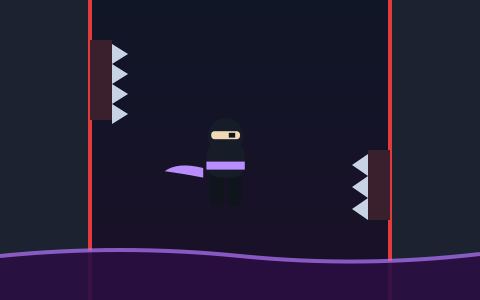
Ninja Climb is the clearest example. The ninja clings to a wall and slides downward at 120 pixels per second while she waits, and a rising flood is climbing toward her. Hesitation has a price, denominated in the same currency as the score.
Once stopping costs something, every decision becomes a decision about tempo rather than safety, which is what people mean when they talk about flow.
Momentum is the resource
Parkour games are built around preserving speed rather than around avoiding hazards. Three mechanics do the preserving.
Wall jumps convert contact with a vertical surface into a fresh jump instead of a dead stop. Without them, hitting a wall in a fast game ends your run; with them, a wall is another surface to move along.
Chained landings carry horizontal speed through a touchdown. Games that zero your velocity on landing feel sticky; games that preserve it feel fast.
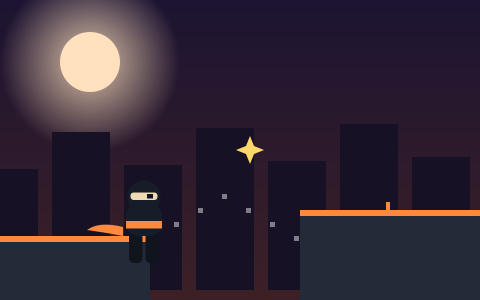
Charged leaps let you spend time to buy distance. Rooftop Ninja inverts the usual trade — you stop to charge, and the charge buys reach — which makes the pause a deliberate cost rather than free hesitation.
Route reading
The skill that separates competent parkour players from good ones is not execution. It is reading the route two moves ahead.
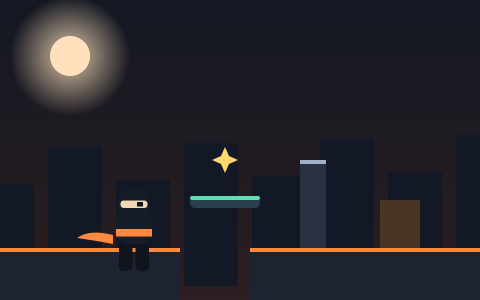
In Ninja Obstacle Master the course is assembled from eight hand-designed blocks. Once you recognise a block from its first obstacle, you already know the next three, and you can start setting up for the third while executing the first. Players who read one obstacle at a time top out well below players who read blocks.
A practical way to build this: after each failed run, name the block that killed you. Not "a wall" — "the double tower". Naming forces recognition, and recognition is what buys you the extra second.
The three parkour verbs
Almost every parkour game in the browser builds from the same three moves.
Wall jump
Contact with a vertical surface gives a new jump, usually with a fixed velocity and a short lockout so you cannot re-grab the same wall immediately. The lockout is why spamming the button does not work.
Slide
A slide shortens the character's collision box for a fixed duration, letting you pass under obstacles at speed. Crucially it cannot usually be cancelled, so it is a commitment to the next half second.
Vault or fast-fall
A way to get down quickly. In these games it is a fast-fall: press down in the air and the character drops immediately. It exists so that an over-long jump is recoverable rather than fatal, and it is the most under-used control by new players.
What makes parkour feel good
Four design details, all invisible when present and glaring when absent.
Input on the next frame. Any perceptible delay between press and movement destroys the sense of control that the whole genre is selling.
Generous but honest hitboxes. Collision boxes are inset a few pixels from the drawn character, so visually close calls survive. Beyond a small margin this becomes dishonest and players lose trust in what they see.
Telegraphed hazards. Anything dangerous must be visible before it can hurt you. In a game where you are moving fast by design, a hazard that appears without warning is not a challenge, it is a coin flip.
Recoverable mistakes. A game that punishes every imperfect move with a restart stops feeling like flow and starts feeling like a test. Wall jumps, fast-falls and soft-fail rules all exist to let a botched move become a recovered one.
Vertical parkour and the tempo problem
Vertical games — Ninja Climb, Shadow Jump — have a structural issue: gravity is working against progress the entire time, so any pause is a loss of height.
Designers solve this in two ways. Some add a rising hazard so hesitation has a visible cost; some make the character bounce automatically so there is no option to stop. Both convert the vertical axis into a metronome.
The checkpoint is the counterweight. Ninja Climb pushes the flood back below the screen every 1,200 height, which gives a long climb a rhythm of pressure and relief rather than one unbroken squeeze.
How to get better at parkour games
- Never wait on a wall unless you are waiting for something specific. A drifting spike is a reason. Nerves are not.
- Wait below a moving hazard, not above it. Below, only the clock threatens you. Above, the hazard can come to you.
- Use the fast-fall. It is the difference between a long jump being a mistake and being an adjustment.
- Learn blocks, not obstacles. Name the pattern that beat you, and you will recognise it next time.
- Aim for the extreme of a moving platform's travel. It is momentarily stationary there, which is the widest landing window you will get.
Key takeaways
- Parkour games make stopping costly, which turns every decision into a question of tempo.
- Momentum is the resource; wall jumps, chained landings and charged leaps all exist to preserve or trade it.
- Reading routes two moves ahead beats reacting to one obstacle at a time.
- Good parkour feel comes from instant input, slightly generous hitboxes, telegraphed hazards and recoverable mistakes.
- Vertical parkour needs a pacing device — a rising hazard, auto-bouncing, or checkpoints.
Frequently asked questions
What is the difference between a parkour game and a platformer?
A platformer lets you stop and plan; a parkour game charges you for stopping. The physics are usually identical — the pressure is what differs.
How do I stop losing runs to walls?
Wall jump the instant you make contact. In Ninja Obstacle Master you have roughly a fifth of a second before the scrolling course starts pushing you toward the left edge.
Are parkour games harder than normal platformers?
They are less forgiving of hesitation but often more forgiving of imprecision, because the recovery moves — wall jumps, fast-falls — are designed to rescue an imperfect input.
Which ninja parkour game should a beginner try first?
Ninja Climb. It uses a single input and a fixed launch velocity, so you learn the rhythm without also managing aim.
Do parkour games teach real parkour?
No, and no responsible game claims otherwise. These are abstract timing challenges with stylised movement; nothing in them corresponds to a real physical technique.
Ready to put this into practice?
Everything above is easier to feel than to read about. Open the game and try one run with just one of these ideas in mind.