The defining feature of a platform game is commitment. Once the character leaves the ground, the arc is decided and you cannot take it back. Everything interesting in the genre comes from that one constraint.
The jump is set before you leave the ground
A platformer jump is three numbers: the upward velocity at take-off, the downward acceleration applied every frame, and how far you travel horizontally while airborne.
Mystic Ninja uses 700 pixels per second upward against 2,000 px/s² of gravity, at a maximum run speed of 300 px/s. From those three numbers everything else follows:
apex      = v² / (2g)        = 700² / 4000   ≈ 122 px
air time  = 2v / g           = 1400 / 2000   = 0.70 s
reach     = airTime * speed  = 0.70 * 300    ≈ 210 px
Those figures are the game's vocabulary. Any platform higher than 122 pixels above you is unreachable in one jump; any gap wider than 210 pixels cannot be crossed at full speed. Level generation is built inside that envelope — pits are capped at 78% of the reach, floating platforms at 82% of the apex — which is why a generated level can never trap you.
Learning to see the envelope is most of what "getting good at platformers" means. After a few runs you stop measuring gaps and start knowing them.
One-way platforms
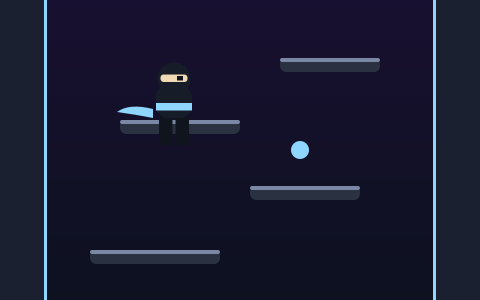
In most platformers, floating platforms are solid from above and empty from below. Jump up through one and you pass; land on it from above and you stand.
This is not laziness, it is a routing tool. One-way platforms let a level offer a high road and a low road through the same space, and they remove an entire category of frustration — bumping your head on the platform you were aiming for.
The implementation is a conditional collision: the game only checks the platform when the character is falling and the feet were above the platform's top edge on the previous frame.
Coyote time and other small mercies
Good platformers lie to you slightly, in your favour.
Coyote time. For a short window after walking off a ledge — 90 milliseconds in Mystic Ninja — a jump press still works even though the character is technically in the air. Without it, players feel the game "ate" their input. With it, nobody notices anything except that the game feels fair.
Jump buffering. A jump pressed slightly before landing is remembered and fires on touchdown.
Forgiving hitboxes. The collision box used for hazards is usually smaller than the drawn character — six pixels of inset on each side in most games here. Visually close calls survive, which is exactly what a player expects.
None of these are cheats. They correct a mismatch between what the player perceived and what the simulation recorded. A platformer that refuses all of them is not more honest, it is just worse to play.
Wall jumping
A wall jump converts contact with a vertical surface into a fresh jump. The two common versions feel completely different.
Fixed-velocity wall jumps. Ninja Climb launches the ninja at the opposite wall at a set speed. Because the velocity never changes, the only decision is timing — it is a rhythm game.
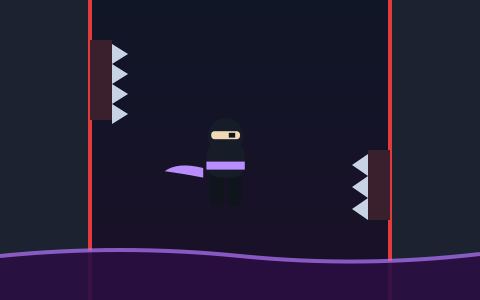
Recovery wall jumps. Shadow Jump uses the tower walls as an emergency net: drift into one while falling and you bounce back toward the middle. Here the wall jump exists to make mistakes recoverable rather than to be the main mechanic.
Knowing which kind you are playing changes your strategy completely. In the first, you seek out walls. In the second, you use them when a plan has already failed.
Vertical versus horizontal
Vertical platformers scroll the world downward as you climb and score your height. They tend to be about momentum: since you are usually moving upward automatically, the challenge is lateral positioning.
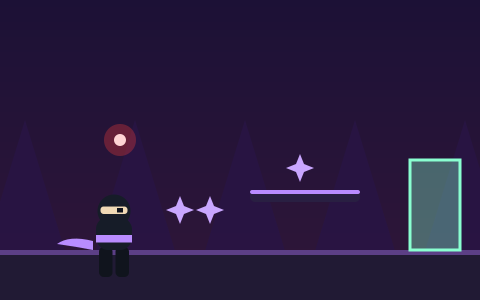
Horizontal platformers scroll sideways and put a goal at the end. They tend to be about routing: multiple paths, collectibles off the critical line, and a decision about how much risk to take for them.
Both use the same physics. They ask different questions with it.
Moving platforms
A moving platform is a platform whose position is a function of time — usually a sine wave. The important detail for you as a player is the effective landing window: the time during which the platform is in a position where your jump would reach it.
That window is longest when the platform is at the extreme of its travel, because it is momentarily stationary. This is why experienced players wait for a platform to reach the bottom of its arc before jumping: the target is briefly not moving.
Falling is a mechanic, not a punishment
In a well-designed platformer, falling is information. It tells you the jump was set up wrong — wrong approach speed, wrong release point, wrong platform choice — and since the level is still there, you can test a different setup.
This is why the good platformers restart instantly. Mystic Ninja returns you to the start of the level with your score and collected gems intact, because the point of the restart is to let you try a different plan, not to punish you for the last one.
How to actually get better
Five habits, in order of how much they help.
- Release movement before you reach the edge. Momentum carries further than players expect. Stopping input about a body-width early is the single biggest improvement available.
- Look at the landing, not the character. Your eyes should be on the platform you are aiming for from the moment you decide to jump.
- Learn the arc, not the gaps. Once you know your jump covers about 210 pixels, every gap becomes a yes or a no rather than a guess.
- Wait for moving platforms at the extremes. The target is stationary there.
- Treat one-way platforms as routes. If you can pass upward through them, the level has more paths than it looks like it has.
Key takeaways
- A jump is fully determined at take-off by upward velocity, gravity and horizontal speed.
- Level generation is constrained by that arc, so a well-built platformer cannot generate an impossible gap.
- One-way platforms create multiple routes and remove head-bump frustration.
- Coyote time, jump buffering and inset hitboxes correct the gap between perception and simulation.
- Wall jumps come in two flavours: rhythm mechanics and recovery nets. Identify which you are playing.
- Moving platforms are easiest to land on at the extremes of their travel.
Frequently asked questions
Why do I keep overshooting platforms?
Momentum. Most players hold the movement key until the character is above the target, by which point it is too late to stop. Release about a body-width early and the character coasts into place.
What is coyote time?
A short grace period after walking off a ledge during which a jump press still works. It is usually under a tenth of a second, and it exists because players genuinely believe they pressed jump before leaving the ground.
Can I jump through platforms in ninja platform games?
In the floating-platform variety, yes — they are one-way. Solid ground is not. On this site, Mystic Ninja's floating platforms can be jumped up through and its ground cannot.
Which ninja platform game is easiest for beginners?
Shadow Jump, because the ninja bounces automatically. With no jump timing to learn, the only skill is steering.
How do wall jumps work?
Contact with a wall gives you a new jump. Some games cling automatically and launch you at a fixed velocity; others simply let you bounce off the wall to recover a bad jump. Both are wall jumps, but they are used completely differently.
Do platform games generate impossible levels?
They can if the generator is not constrained. Well-built ones — including every platformer here — check generated distances against the character's actual jump arc before placing anything.
Ready to put this into practice?
Everything above is easier to feel than to read about. Open the game and try one run with just one of these ideas in mind.