A timing game asks exactly one question, repeatedly: when? Everything else is fixed, which is what makes the genre so unforgiving and so learnable at the same time.
The two numbers that define a timing game
Window size — how much room for error you have. Approach speed — how fast the window arrives and passes.
Together they produce the only figure that matters: how long the window is open in real time.
In Ninja Reflex that starts generously and narrows hard:
| Stage | Sweep speed | Window width | Time open |
|---|---|---|---|
| Start | 2.1 rad/s | 0.84 rad | ~400 ms |
| Mid | 4.5 rad/s | 0.50 rad | ~110 ms |
| Capped | 7.4 rad/s | 0.26 rad | ~35 ms |
That final figure explains why waiting for visual confirmation cannot work. Nothing reacts inside 35 milliseconds. At that stage you are anticipating a known cycle, not responding to a signal.
Escalating on two axes
The trick that keeps a one-input game interesting is changing both numbers at once.
Ninja Reflex adds 0.16 rad/s of speed and removes 0.012 rad of width per successful strike. Either alone would plateau; together they compound, which is how a game with one button stays demanding for minutes.
Why every good timing game has a forgiveness window
If the window were exactly as wide as the target, every input would need to be frame-perfect and nobody would play.
So timing games build in forgiveness in three ways:
A wider window than it looks. Ninja Reflex's zone is drawn with a pale core marking the high-scoring centre, but the whole coloured band counts as a hit.
Graded outcomes. Rather than hit-or-miss, the result is scaled: a centre strike is worth three times an edge strike. You are rewarded for precision without being punished for imprecision.
Easing after failure. After a miss, Ninja Reflex slows by 0.35 and widens by 0.03. A bad moment does not cascade.
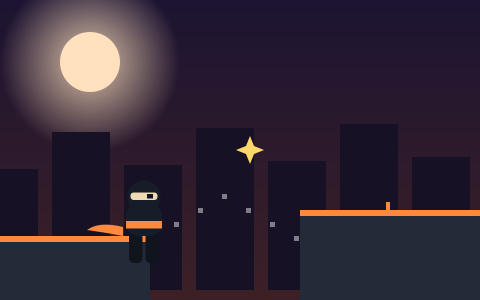
Rooftop Ninja uses the same pattern. A perfect landing needs the centre 26% of the rooftop, but a safe landing anywhere on it is worth 30 points and keeps you alive. Precision is rewarded; imprecision is survivable.
Timing versus rhythm
Worth distinguishing, because it changes how you practise.
A rhythm game has a regular beat you can settle into. A timing game has irregular intervals, so each window must be judged individually.
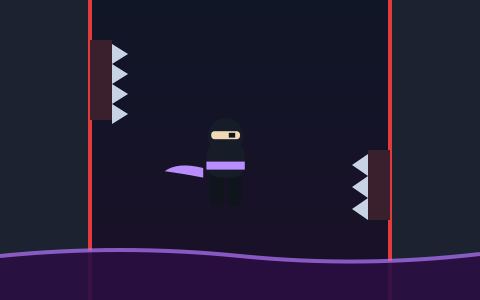
Ninja Climb sits between the two. The wall jump itself is rhythmic, but drifting spikes impose irregular waits, so you settle into a rhythm and then break it deliberately.
Ninja Reflex actively resists rhythm: a 28% chance of direction reversal after each hit exists specifically to stop muscle memory doing the work.
How to get better at any timing game
- Find the constant. Sweep speed, charge rate, bob period. Time against the cycle.
- Press on approach. By the time you confirm, you are late.
- Watch the gap closing, not the moving object. A shrinking distance is easier to judge.
- Discretise analogue inputs. Three learnt charge levels beat a guessed continuum.
- Expect the irregularity. Reversals and drifting hazards exist to catch out pure muscle memory.
Key takeaways
- Timing games are defined by window size and approach speed; what matters is how long the window is open in real time.
- Escalating both axes at once is what keeps a single-input game demanding.
- Forgiveness comes from generous windows, graded outcomes and easing after failure.
- Rhythm games have a beat; timing games have irregular intervals that must be judged individually.
- Improve by finding the constant, pressing on approach and watching the closing gap.
Frequently asked questions
What is a timing-based game?
One where the only decision is when to press. Position, target and response are all fixed; the moment is everything.
Why do I keep missing when I press at the right moment?
Because you pressed when you saw it was right, which is a couple of hundred milliseconds after it was. Move the press onto the approach.
Are timing games the same as rhythm games?
No. Rhythm games have a regular beat to settle into; timing games use irregular intervals, so each window is judged on its own.
Which ninja game is the purest timing game?
Ninja Reflex. One input, one visible window, nothing else on screen.
Ready to put this into practice?
Everything above is easier to feel than to read about. Open the game and try one run with just one of these ideas in mind.