Calling something a puzzle game usually implies you solve it with your head and a reflex game implies you solve it with your hands. Arcade skill games sit awkwardly between the two, and the useful distinction is not about which body part you use — it is about whether the challenge is knowable in advance.
The test: can you plan it?
If the correct action can be worked out before the moment arrives, you are playing a puzzle. If it can only be discovered when the moment arrives, you are playing a reflex test.
By that measure, a lot of "reaction games" are actually puzzles:
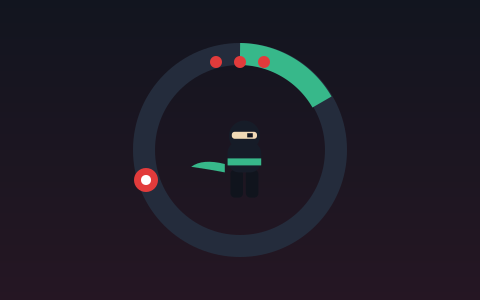
- Ninja Reflex looks like a reflex test. But the marker moves at a known constant speed, the target is visible for its entire approach, and the correct press time is calculable. It is a rhythm puzzle.
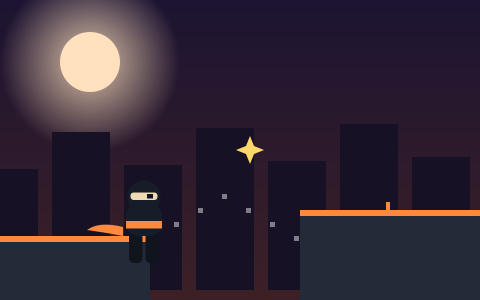
- Rooftop Ninja shows you the predicted arc while you charge. The answer is on screen; the challenge is executing it.
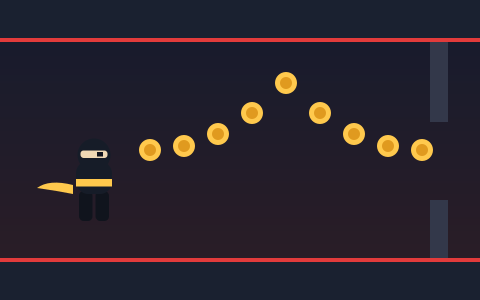
- Ninja Coin Rush shows a whole pattern before you reach it. Choosing the route is a plan, not a reaction.
Genuine reflex tests are rarer than the marketing suggests, and they are usually the games where the information arrives too late to be useful — which is often a design flaw rather than a feature.
Two families of arcade puzzle
Timing puzzles
The question is when. Everything else is fixed.
Ninja Reflex is the clearest case, and its solution is counter-intuitive: press as the marker reaches the edge of the target, not its centre. Human visual reaction latency is a couple of hundred milliseconds, so by the time you have confirmed the marker is inside the window, your press will land outside it.
Ninja Climb is the same family in a different costume. The launch velocity is fixed, so a wall jump is purely a question of when you leave — early enough to beat the rising flood, late enough that a drifting spike has moved out of the landing band.
How to approach a timing puzzle: stop reacting and start predicting. Find the constant — the sweep speed, the bob period, the drift cycle — and time your input against that rather than against the moment of arrival.
Routing puzzles
The question is which path. Time pressure exists but the decision is spatial.
Ninja Coin Rush is the archetype: four coin patterns, a barrier with a guaranteed gap behind most of them, a combo that dies on contact and a clock that only moves one way. Every pattern offers a cheap route and a greedy one, and the greedy one risks three seconds plus a multiplier reset.
Mystic Ninja is a slower version. Gems sit on the high route; the ground is faster and safer. Which one you take should be decided before you start climbing, not halfway up.
How to approach a routing puzzle: decide before you arrive, then commit. Most failures in routing games happen in the middle of a changed mind.
Precision puzzles: the third kind
Rooftop Ninja belongs to a smaller family where the challenge is how much. Charge is a continuous quantity, and the puzzle is mapping a visible distance onto a hold duration.
The practical approach is discretisation. Instead of trying to produce a continuous range of charges, learn three: a quarter, a half and three quarters of the meter. Almost every gap in the game falls into one of those buckets, and classifying a gap is far faster and more repeatable than measuring it.
This is a general lesson about analogue inputs in games: humans are bad at continuous estimation and good at classification. Turn the continuum into categories and your consistency improves immediately.
Why puzzle framing helps you play better
Treating these games as reflex tests produces a specific failure mode: you wait, you confirm, you react, and you are always slightly late. Nothing about that improves with practice, because the latency is physiological.
Treating them as puzzles changes what you practise. You start looking for the constant, you start pressing on approach, you start deciding routes before you arrive. All of those are learnable, and all of them produce immediate improvement.
If a game feels like it demands superhuman reflexes, look for the information you are ignoring. In a well-built game it is almost always on screen before you need it.
When a game really is a reflex test
There are genuine cases — usually where a hazard's behaviour is randomised at the last moment, or the approach is too short to plan within.
Even then, the skill that improves is anticipation rather than raw speed. In Shuriken Sprint at top speed, players who track the gap between hazards rather than the hazards themselves perform considerably better, because they have converted a two-object tracking task into a one-object search.
Reflex games reward pattern priors. Raw reaction time is roughly fixed; what improves is how much you have already narrowed the possibilities before the signal arrives.
Key takeaways
- The useful distinction is whether the correct action is knowable in advance, not whether you use your head or your hands.
- Timing puzzles have a constant to time against — find it, and press on approach rather than on arrival.
- Routing puzzles are decided before you arrive; committing beats improvising.
- Precision puzzles get much easier if you discretise a continuous input into three or four learned levels.
- In genuine reflex situations, improvement comes from anticipation and narrowing possibilities, not from faster reactions.
Frequently asked questions
What is the difference between a puzzle game and a reaction game?
Whether the answer can be worked out in advance. If the information is on screen before you need it, it is a puzzle even when it demands fast hands.
Is Ninja Reflex a puzzle or a reaction game?
Mostly a puzzle. The marker moves at a known speed and the target is visible throughout, so the correct press time is calculable — which is why pressing on approach works so much better than waiting.
How do I get better at timing-based games?
Find the constant the game runs on and time against it. Then move your input earlier than feels right, because visual confirmation takes longer than most people realise.
What is the best ninja puzzle game to start with?
Ninja Reflex for timing, Ninja Coin Rush for routing. Both are rated Easy and both reveal their structure within a couple of rounds.
Do these games have a single correct solution?
Timing puzzles do — there is one optimal moment. Routing puzzles have several acceptable answers with different risk profiles, which is what makes them interesting to replay.
Ready to put this into practice?
Everything above is easier to feel than to read about. Open the game and try one run with just one of these ideas in mind.