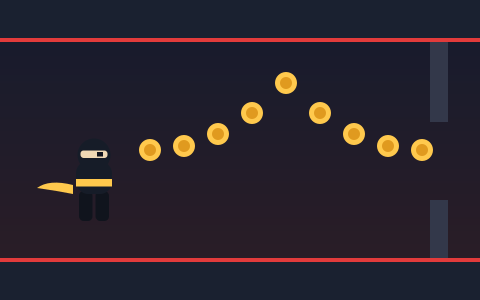
The games in this category look like reflex tests and behave like problems. Treat them as problems and your scores move immediately.
1. Find the constant
Every timing challenge runs on something regular. Identify it and time against the cycle rather than against the moment of arrival.
- Ninja Reflex: the marker's sweep speed is constant between hits.
- Rooftop Ninja: the charge meter fills at a fixed 1.35 units per second.
- Ninja Climb: drifting spikes follow a fixed-period sine wave.
- Ninja Coin Rush: barriers appear roughly 500 pixels behind the pattern they guard.
That last one is the most useful and least obvious. You can read the barrier's gap position while you are still collecting the pattern in front of it, which turns a reaction into a plan.
2. Decide before you arrive
Routing failures almost always happen in the middle of a changed mind.
In Ninja Coin Rush, pick your line as a pattern enters the right edge — which coins you are taking, which you are skipping, and which side of the corridor the barrier gap is on. Then execute it. A mediocre plan executed cleanly beats a good plan abandoned halfway.
3. Discretise analogue inputs
Rooftop Ninja's charge is continuous. Do not treat it that way.
Learn three levels — roughly a quarter, a half and three quarters of the meter — and classify each gap into one. Humans are unreliable at continuous estimation and good at classification, so three learnt buckets produce far better consistency than an infinite range you are guessing at.
4. Protect the chain, not the item
In Ninja Coin Rush at an eight multiplier each coin is worth 80 points. A barrier hit costs three seconds and resets you to ten points a coin, and rebuilding takes 56 coins in a sixty-second game.
So skipping the two outlying coins in a cluster to keep your line clean is not caution. It is the higher-scoring play by a wide margin.
5. Spend everything in the final seconds
The value of caution comes from having a run left to protect. In the last five seconds of a timed game there is nothing left to protect.
Take every risk in that window: the awkward coin, the tight gap, the lantern that requires crossing the corridor. The expected cost of failure is nearly zero.
This asymmetry — conservative early, reckless late — is the single most useful strategic idea in timed collection games.
Pattern-specific notes for Ninja Coin Rush
Arc. Nine coins over a 130-pixel rise. Start moving as it enters the screen; the acceleration is quick but not instant.
Line. Eight coins at one height. Free points — take all of them.
Zigzag. Ten coins alternating 62 pixels above and below a baseline. Chasing every one costs more time than the coins are worth. Ride the middle and take half.
Cluster. Twelve coins in a compact block. The best value pattern in the game, and usually worth a small detour.
Approaching Ninja Reflex as a puzzle
Three things, in order:
- Press as the marker reaches the edge of the zone, not its centre. Confirmation arrives too late at any real speed.
- Watch the closing gap rather than the marker. A shrinking distance is easier to judge than a fast-moving object.
- Expect the reversal. Roughly one hit in four flips the direction, and it catches out players running on pure muscle memory.
Key takeaways
- Find the constant each game runs on and time against the cycle.
- Decide your route before the pattern arrives, then commit to it.
- Turn continuous inputs into three learnt levels.
- Protect the multiplier rather than the individual collectible.
- Play conservatively while there is a run left to protect, and spend everything in the final seconds.
Frequently asked questions
Are these really puzzles rather than reflex games?
Mostly. The information you need is on screen before you need it, which makes the answer knowable in advance — the definition of a puzzle, even when it demands fast hands.
How do I score higher in Ninja Coin Rush?
Protect the chain. At maximum multiplier a coin is worth eight times its base value, so avoiding barriers matters more than collecting everything.
What is the best strategy for Ninja Reflex?
Press on approach rather than on arrival, aim for the pale core of the zone, and stay calm after a miss — the game eases off, making the next two strikes the easiest in the run.
Should I ever take a risky route?
Early in a run, rarely. In the last few seconds of a timed round, always — there is no remaining run for a mistake to cost you.
Ready to put this into practice?
Everything above is easier to feel than to read about. Open the game and try one run with just one of these ideas in mind.