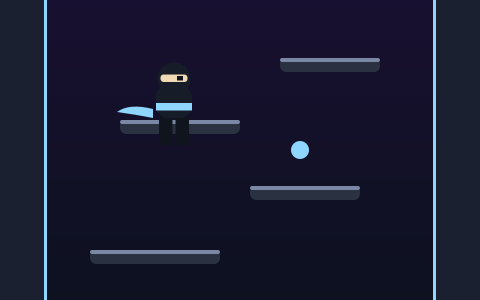
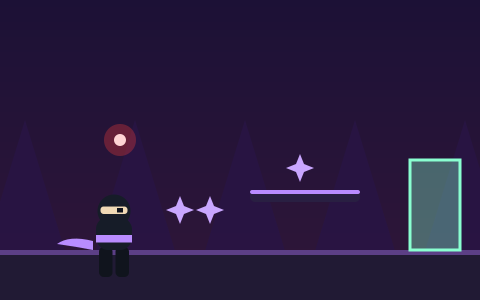
"Endless" is a structural choice, not a genre. A runner can be endless or level-based; a platformer can be either. What the choice determines is where a run's meaning comes from.
What endless actually means
An endless game has no completion state. There is no final level, no ending, no "you win". A run continues until you fail, and the score is the outcome.
Content is generated or recycled as you play rather than authored in advance, which is what allows a run to continue indefinitely from a small amount of material.
Which games here are endless
| Game | Structure |
|---|---|
| Ninja Dash | Endless |
| Shadow Escape | Endless |
| Shuriken Sprint | Endless |
| Shadow Jump | Endless |
| Ninja Climb | Endless |
| Rooftop Ninja | Endless |
| Ninja Obstacle Master | Endless |
| Ninja Reflex | Endless, three misses |
| Ninja Coin Rush | Fixed 60 seconds |
| Mystic Ninja | Endless levels, three lives |
Eight of ten are fully endless. Ninja Coin Rush has a fixed clock, and Mystic Ninja generates levels indefinitely but gives them boundaries and goals.
What endless gets you
No content ceiling. A small amount of material supports unlimited play. Ninja Dash has three obstacle types and can run forever.
Instant restarts. With no level state to load, restarting is one key press — which matters enormously when a run lasts ninety seconds.
Honest scoring. Every run starts from identical conditions, so scores compare directly. There is no "I had a better starting position".
Difficulty as content. Escalation replaces new material. Instead of designing a harder level, the game gives you less time.
What endless gives up
Narrative and sense of completion. You never finish anything. For some players that is fine; for others it is why they bounce off the whole genre.
Authored moments. A designer cannot build a specific set piece at a specific point, because there are no points — only tiers and probabilities.
A stopping cue. Level-based games tell you when to stop. Endless games do not, which is why it is worth setting your own — a target score, or a fixed number of runs.
The middle ground
Mystic Ninja shows the compromise. Levels are generated indefinitely, but each one has a start, an exit gate and a clear bonus.
What that buys: a sense of completion every three to ten minutes, a natural place to stop, and progress that persists within a run even when a life is lost. What it costs: slightly less pure score comparison, since a run's score depends partly on how many levels you reached.
For most players it is the friendlier structure, and it is the game we recommend when someone says endless runners leave them cold.
The psychology of no ending
Worth being straightforward about this. Endless games are designed to be replayed, and the mechanisms that encourage replay are deliberate: a visible best score, a fast restart, a near-miss that felt recoverable.
None of that is manipulative on its own. It becomes a problem when a game adds artificial urgency — timers you must return for, streaks you lose by not playing, rewards for daily attendance.
There is none of that here. No notifications, no daily streaks, no reason to come back other than wanting to. The editorial policy covers where we draw that line.
Key takeaways
- Endless means no completion state; the run ends when you fail and the score is the outcome.
- Eight of the ten games here are endless; one has a fixed clock and one uses generated levels.
- Endless buys unlimited play, instant restarts and honest score comparison.
- It gives up narrative, authored moments and any natural cue to stop.
- Level structure is the middle ground, and it suits players who want a sense of completion.
Frequently asked questions
Can you beat an endless game?
Not in the traditional sense. The only meaningful target is your own previous best, stored in your browser and shown on the game-over screen.
Why do endless games not get boring?
Because difficulty escalation keeps changing the conditions, and because a run is short enough that the loop refreshes constantly. Whether that works for you is a matter of taste.
Which ninja game has an actual ending?
None has a final ending, but Mystic Ninja has levels that end, which gives a run structure and natural stopping points.
How do I know when to stop playing?
Set your own cue, since the game will not give you one — a target score or a fixed number of runs both work well.
Ready to put this into practice?
Everything above is easier to feel than to read about. Open the game and try one run with just one of these ideas in mind.