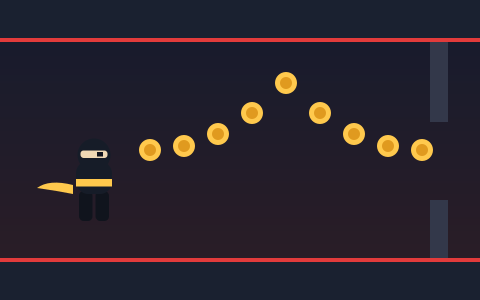
A power-up is a temporary change to the rules. That is a more radical thing than it sounds, because every other system in the game — level generation, difficulty scaling, scoring — was built assuming the rules were constant.
The four kinds
Almost every arcade power-up fits one of four categories, and each solves a different problem.
1. Ability power-ups
They give you a verb you did not have. The double jump in Mystic Ninja is the example: eighteen seconds during which a second mid-air jump becomes available.
These are the most transformative and the most dangerous to balance, because they change what is reachable. A generator that placed a pit at the limit of the single jump has just had its constraint invalidated.
2. Protection power-ups
They absorb a failure. Shields, extra lives, invulnerability windows. Shadow Escape gives 1.1 seconds of invulnerability after a hit — technically automatic rather than collected, but the same category.
These are the safest to balance because they do not change what you can do, only what happens when you fail.
3. Resource power-ups
They restore something being consumed. The lanterns in Ninja Coin Rush add three seconds to a sixty-second clock; the light orbs in Shadow Escape push the pursuing wall back twelve pixels.
Resource power-ups are the most elegant fit for arcade games, because they give the player something to do about rising pressure other than play perfectly.
4. Scoring power-ups
They multiply points without changing gameplay. Rare in these games, because a multiplier that arrives by luck rather than by skill weakens the link between play quality and score.
Duration matters more than strength
A common design instinct is to make a power-up dramatic. The better instinct is to make it long enough to plan around.
Mystic Ninja's double jump lasts eighteen seconds. That is long enough to cross several pits, decide to take a high route, and still reach the gate — long enough to be a plan rather than a moment.
Compare a hypothetical three-second version. It would be strictly more powerful per second and far less interesting, because there would be no time to do anything except use it on whatever happened to be in front of you.
The question a power-up should provoke is "what should I do with this?" A power-up too short to answer that question is just a points bonus in a costume.
The generation problem
If a power-up changes what you can reach, every generation constraint has to account for it.
There are three ways to handle this, in increasing order of effort:
Ignore it. Design levels for the base ability and let the power-up make them easier. This is what Mystic Ninja does — pits are capped against the single jump, so the double jump is a safety margin rather than a key. Simple, safe, and it means the power-up never becomes mandatory.
Gate content behind it. Place unreachable bonuses that only a powered-up player can get. Rewarding, but it requires the generator to know whether the player is currently powered up.
Generate two layouts. Full branching. Powerful and rarely worth the complexity in an arcade game.
The first approach is almost always right for a short-session game, because it guarantees that a player who never finds the power-up can still complete everything.
Where power-ups should appear
Placement communicates intent.
- On the safe route, a power-up is a reward for playing well.
- On the risky route, it is a bet — you take a chance to gain an advantage.
- After a difficult section, it is a relief valve, which is the most player-friendly placement.
- Before a difficult section, it is a hint that the section is coming.
Mystic Ninja places its power-up somewhere in the middle third of each level from level two onward, generally above ground level, so reaching it usually costs a small detour.
Carrying power-ups between stages
A subtle design choice with a large effect: if a level clear happens while a power-up is active, does the remaining time carry over?
Mystic Ninja says yes. That single rule creates an optimisation: grab the power-up, clear the level quickly, and start the next one already powered. It converts the power-up from a local convenience into a reason to play the level efficiently.
Rules like this are cheap to implement and add a layer of strategy that costs nothing in complexity.
When to spend one
Four practical guidelines that apply across arcade games:
- Use ability power-ups on structural problems, not convenience. A double jump is worth most crossing a wide pit, least hopping a crate you could clear anyway.
- Use resource power-ups immediately. Time and distance do not benefit from being saved, and in Ninja Coin Rush the clock caps at sixty seconds, so a lantern taken while near-full is partly wasted.
- Do not detour for a power-up when you are close to a goal. If the gate or the checkpoint is near, bank the progress.
- Never risk a run to reach one. The expected value of a power-up is always less than the expected remaining value of the run.
Key takeaways
- The four types are ability, protection, resource and scoring power-ups; each solves a different design problem.
- Duration matters more than strength — a power-up should be long enough to plan around.
- Level generation should assume the base ability, so a power-up is a margin rather than a key.
- Placement communicates intent: after a hard section it is relief, before one it is a warning.
- Spend ability power-ups on structural obstacles, spend resource power-ups immediately, and never risk a run to collect one.
Frequently asked questions
What power-ups are in Ninja Arcade games?
Mystic Ninja has an eighteen-second double jump. Ninja Coin Rush has lanterns that add three seconds. Shadow Escape has light orbs that push the pursuing shadow back.
Do power-ups carry between levels?
In Mystic Ninja, yes — remaining double-jump time carries into the next level if you reach the gate before it expires.
Are power-ups required to finish a level?
No. Levels are generated against the character's base abilities, so everything is reachable without any power-up.
Why is the double jump weaker than the first jump?
At 88% of the first jump's strength, it is useful for correcting a mistimed jump without doubling the character's effective reach — which would invalidate every level-generation constraint at once.
Should I always grab a power-up when I see one?
Only when it is on or near your route. The expected value of finishing the run intact is higher than any single power-up, so a risky detour is a losing trade.
Ready to put this into practice?
Everything above is easier to feel than to read about. Open the game and try one run with just one of these ideas in mind.