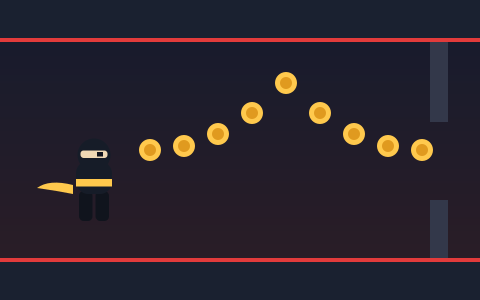
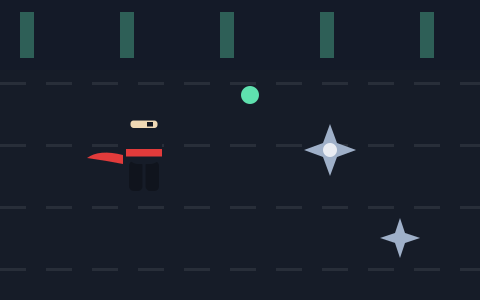
A multiplier looks like a simple reward. It is actually three separate design decisions, and each one changes how the game wants you to play.
Decision 1: how fast it builds
The step size determines how quickly a player feels progress.
| Step | Effect | Example |
|---|---|---|
| Every 1 action | Immediate, volatile | Rooftop Ninja — one perfect landing per step |
| Every 3–4 | Responsive, still meaningful | Ninja Reflex, Ninja Obstacle Master |
| Every 6–8 | Slow, feels earned | Shuriken Sprint, Ninja Coin Rush |
Fast steps suit games where individual actions are discrete and deliberate — each one feels like an achievement. Slow steps suit continuous games where actions arrive constantly and a per-action step would hit the cap in seconds.
The rule of thumb: the multiplier should take somewhere between fifteen and forty seconds of good play to max out. Faster and it stops being an aspiration; slower and most players never see it.
Decision 2: where it stops
Caps in these games range from five to ten.
A cap does two things. It prevents a single exceptional run from dwarfing every other score you will ever set, and it gives the player a visible goal. "Get to ×10" is a much clearer objective than "get the multiplier as high as possible".
An uncapped multiplier sounds generous and is usually bad design. It makes the late game the only part that matters, and it makes the score a measure of one lucky session rather than of skill.
Decision 3: what breaks it
This is the most consequential choice of the three.
Reset on any failure. Ninja Reflex drops from ×10 to ×1 on a single miss. Brutal, and it produces a game about precision — because precision is the only thing that protects you.
Reset on damage only. Ninja Coin Rush keeps the chain through missed coins and only resets on barrier contact. This lets you skip collectibles freely, which is what makes it a routing game rather than a completion game.
Never reset mid-run. Shuriken Sprint's multiplier only ends when the run does. That produces a game about endurance: survive and the multiplier looks after itself.
Read which rule a game uses and you know what it is asking of you — precision, routing, or endurance.
Decay: the option none of these games use
A fourth possibility is a multiplier that slowly falls when you stop performing, rather than resetting on failure. It creates constant low-level pressure to keep acting.
It suits longer games, and it suits these poorly. In a ninety-second run, decay would mostly punish players for the brief pauses the games already demand — waiting for a hazard cycle, charging a jump, planning a route.
Mentioning it is worth doing because it explains what a reset-based system is choosing not to do: it is choosing to make pauses safe and mistakes expensive, rather than the other way round.
Break-even arithmetic
The useful calculation, in one line: a collectible worth V is worth risking when V > p × R, where p is the chance of failure and R is your expected remaining score.
The multiplier enters that equation on both sides. It raises V, but it raises R by more, because R includes every future collectible at that multiplier.
That is why higher multipliers should make you more cautious, not less. At ×1 a risky grab is cheap. At ×8 it is the most expensive decision on screen.
Showing the multiplier
Every game here displays the current multiplier in the HUD, in the third panel at the top of the play area.
This is not decoration. A player who cannot see their multiplier cannot reason about risk, and the whole system collapses into "collect things and hope". Hiding it would not make the game harder in an interesting way — it would make the central decision unmakeable.
Key takeaways
- Step size sets the pace: fast steps suit discrete actions, slow steps suit continuous ones.
- Caps keep the whole run meaningful and give the player a concrete goal.
- The reset rule tells you what the game values: precision, routing or endurance.
- Higher multipliers should make you more cautious, because they raise your expected remaining score more than they raise any single item's value.
- A multiplier must be visible, or the decision it creates cannot be made.
Frequently asked questions
What is a combo multiplier?
A number that scales the points you earn, raised by consecutive successful actions and lowered or reset by failure.
Why do multipliers have a maximum?
To stop one long run dominating every score you set, and to give players a clear, reachable goal.
Does a higher multiplier mean I should take more risks?
The opposite. A high multiplier raises the value of everything you will earn for the rest of the run, so protecting it is worth more than any single collectible.
Which game has the highest multiplier?
Ninja Reflex, at ×10 — though it also has the harshest reset, dropping to ×1 on any miss.
Ready to put this into practice?
Everything above is easier to feel than to read about. Open the game and try one run with just one of these ideas in mind.