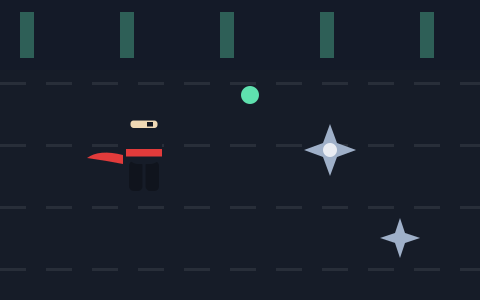
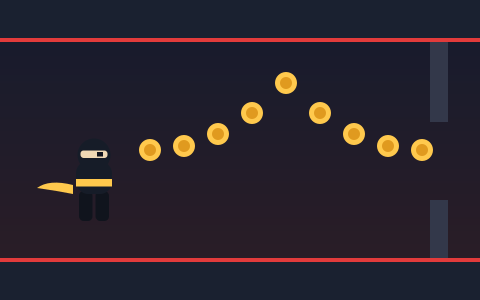
A score is not a record of what happened. It is an instruction about how the designer wants you to play, written in arithmetic. Read it correctly and your play changes; ignore it and you will spend a long time wondering why your runs plateau.
The two-term structure
Nearly every arcade score is the sum of two very different things.
The survival term accrues continuously and cannot be lost. Distance in Ninja Dash, height in Shadow Jump, elapsed time in most others. It is free income: it arrives whether or not you take any risk.
The performance term arrives in chunks and is usually multiplied. Coins, gems, tokens, perfect landings, clean dodges. It requires you to do something optional, and the something optional is where all the danger is.
Everything strategic in arcade scoring falls out of the tension between them.
What a multiplier actually prices
Multipliers look like a reward for skill. They are more precisely a price on consistency.
Consider Ninja Coin Rush: the multiplier rises one step every eight coins, caps at eight, and resets to one the moment you clip a barrier. At full multiplier a coin pays 80 points; at the bottom it pays 10.
So the cost of a collision is not the three seconds it takes off the clock. It is:
lost value = (coins you would collect before rebuilding) × (80 − 10)Rebuilding from one to eight takes 56 coins. Even at a modest rate that is several hundred points of lost value on top of the lost time. The barrier is not the punishment; the reset is.
This is the general shape across the genre. In Shuriken Sprint the multiplier caps at five and only ends with the run. In Ninja Reflex it caps at ten and resets on any miss.
The risk calculation
Here is a calculation worth doing once, because it generalises.
Suppose a collectible is worth V points, and reaching for it carries probability p of ending your run. Your expected remaining score if you survive is R. Taking the risk is worth it when:
V > p × RIn Ninja Dash at mid speed, R for a healthy run is easily 800–1,500 points. A coin arc is worth perhaps 150. So the arc is only worth taking when p is below roughly 10–15%.
Players consistently estimate p at around 5% for grabs that are actually 30% failures. That gap is the single largest source of lost score in arcade games, and it is why "skip the awkward coin" is the most repeated advice on this site.
Accuracy scoring
Some games pay for precision rather than for collection. Ninja Reflex scales points by how close to the centre of the target zone you strike:
accuracy = 1 − (offset / zoneWidth)
points   = round((10 + accuracy × 20) × combo)
A centre strike is worth 30 before the multiplier; an edge strike is worth 10. At a ten multiplier that is 300 versus 100.
The design intent is clear once you see the numbers: the game is not asking you to survive, it is asking you to be exact. A player who understands that stops celebrating narrow hits and starts aiming for the middle.
Why streak bonuses escalate
Several games raise the value of an item as a streak continues rather than only raising a multiplier. Ninja Dash pays 10 points per coin, plus 5 more for every five consecutive coins, capped at 50.
This is a different incentive from a flat multiplier. It rewards uninterrupted collection specifically, which pushes you toward taking complete coin arcs on clean stretches rather than snatching individual coins near obstacles. Reading which kind of bonus a game uses tells you how to route.
Score inflation and why caps exist
Every scoring term on this site has a ceiling: coin values cap at 50, multipliers cap between five and ten, speed caps and therefore distance income caps.
Without caps, a long enough run produces numbers so large that the early game becomes irrelevant, and the score stops measuring anything except patience. Caps keep the whole run meaningful, which is what makes a personal best worth chasing.
What good scoring design avoids
Punishing exploration too hard. If collection is never worth it, the performance term is decorative and the game is just a survival timer.
Making collection mandatory. If you cannot survive without collecting, the risk decision disappears and there is no strategy left.
Hiding the rules. A player who cannot see their multiplier cannot reason about it. Every game here shows the current multiplier or streak in the HUD.
Unbounded multipliers. A multiplier with no cap makes a single long run dominate every other score you will ever set.
Key takeaways
- Arcade scores combine free, continuous survival income with risky, multiplied performance income.
- A multiplier prices consistency: its reset, not the hit itself, is the real cost of a collision.
- Take a risky collectible only when its value exceeds the probability of failure times your expected remaining score — usually meaning failure odds below about 15%.
- Accuracy scoring pays for precision rather than survival, and scales faster than either.
- Caps on values, multipliers and speed keep the whole run meaningful rather than only the end of it.
Frequently asked questions
What is a combo in an arcade game?
A run of consecutive successful actions with no failure in between. Most games convert the length of that run into a multiplier applied to the points you earn.
Why does my multiplier reset when I get hit?
Because the multiplier is the reward for consistency. If it survived mistakes it would stop measuring anything, and the safest strategy would also be the highest scoring one.
Is it better to collect items or survive?
Survive. In every game here the continuous survival term out-earns collection over time, and collection is where the risk is. Collect only what sits on your line.
What is the maximum multiplier?
It depends on the game: five in Shuriken Sprint, six in Ninja Obstacle Master, eight in Ninja Coin Rush and Rooftop Ninja, ten in Ninja Reflex.
Do scores carry between games?
No. Each game keeps its own best score in your browser's local storage, and there is no site-wide total.
Ready to put this into practice?
Everything above is easier to feel than to read about. Open the game and try one run with just one of these ideas in mind.